

Online betting has gone from being a niche pastime to a global, digital industry that attracts hundreds of millions of people. Now nearly 1 in 5 people worldwide gamble, an indication of their level of adoption into daily online activity.
Fueled by the rise of mobile access, live sports betting, and accelerated legalization, the online gambling industry is expanding so fast across regions, demographics, and income levels that it’s emerging as a significant source of opportunity for business and risk to society.
This article examines market size, demographics, regional trends, legality, and societal impact through verified data.
Online Gambling Statistics 2026: Key Highlights
- India’s online gambling market was estimated to have 12.7 million users.
- Around 1 in 5 people gamble globally.
- The global gambling market is projected at $101.45 billion in 2026.
- The Indian online gambling market generated revenue of $5 billion in 2024 and is projected to exceed $10 billion by 2030.
- Europe is the largest market for online gambling, with projected revenue of $63,552.8 million by 2030.
- Mobile and tablet devices generated 53.65% of the online gambling revenue in 2025.
- Fewer than 5% of gamers earn any income from online gambling or gaming platforms.
- Around 45 crore people in India lost ₹20,000 crore to online real-money gaming.
How Many People Gamble Online Globally?
Globally, 17.9% of adolescents, around one in five (19%), gambled in the last 12 months according to The Lancet Public Health Commission, indicating increasing exposure to gambling, particularly among young people.
Source: The Lancet
Early involvement can foster further market expansion and reach 1.1 billion bettors by 2030; the number of gambling users worldwide is expected to grow further. A significant part of this growth is due to online casinos, with it predicted that there will be 139.9 million online casino users by 2029.
Source: Statista
Talking of India, its online gambling market was estimated to have 12.7 million users, and was projected to grow by 8% by 2027.
Source: 360 info
During this period, user penetration is forecast to increase from 3.0% in 2024 to 3.7% by 2029, indicating steady but sustained adoption of online casino gaming worldwide.
Source: Casino Statistics
Online Gambling Statistics In India
A combination of massive scale and gradual monetization has shaped India’s online gambling market growth. In 2024, the market generated $5,015.9 million in revenue and is projected to more than double to $10,776.7 million by 2030, growing at a CAGR of 13.7%.
Source: Grand View Research
This growth is supported by one of the world’s largest gaming communities, with estimates between 550-591 million gamers across platforms, largely fuelled by cheap smartphones, affordable data, and growing digital infrastructure.
Source: LinkedIn
Daily active users also laid bare this momentum, with almost 110 million people gaming each day, representing about 22% of all players. This showed that gaming and gambling platforms were not only widely used but also deeply rooted in daily digital habits.
Source: Animation Xpress
The segment of Indian gamers is getting more diverse. While women constitute nearly 45% of the gaming population, and many of today’s female gamers are aged 18-30, they are predominantly located in non-metro areas.
Source: Storyboard
Despite the large number of users, spending is concentrated among a small group. Out of approximately 568 to 591 million gamers, only around 140 to 155 million users, or roughly 25%, spend money on games or participate in real-money gaming.
This paying segment generates an average revenue per paying user between $22 and $30, a sharp rise from just $2 to $5 five years ago.
Source: Your Story
Although the average revenue per user is still relatively low at $3.03, compared to other established markets like the U.S. and China, ARPPU is growing rapidly, and monetizing efforts are rapidly increasing from paying users.
Source: LinkedIn
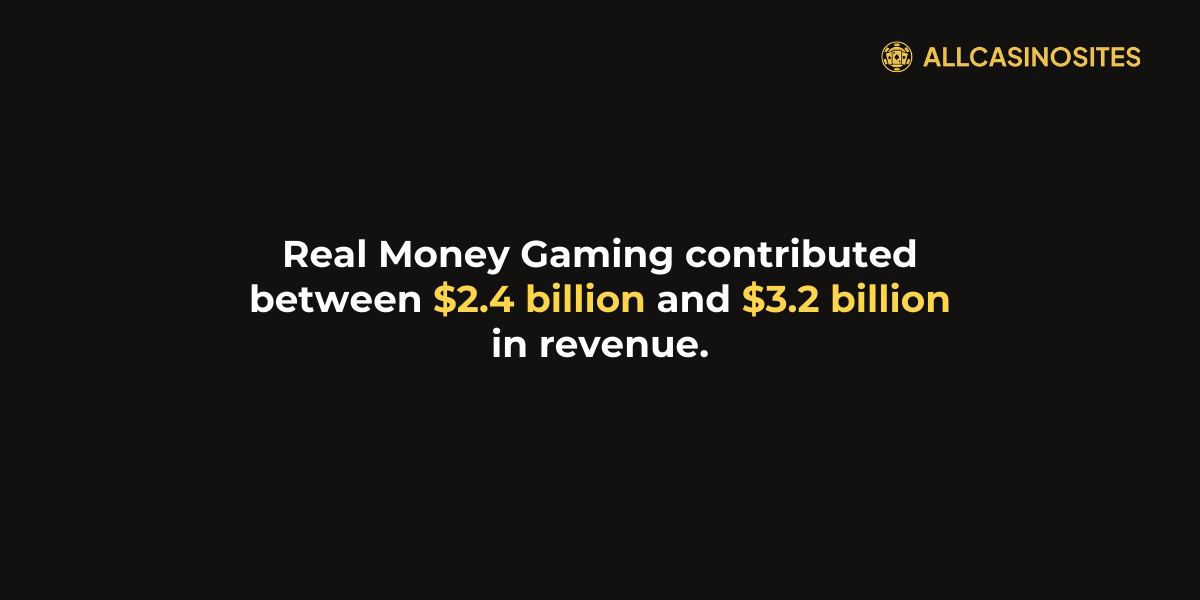
Real-money gaming remains the primary revenue driver in this ecosystem. In 2024, RMG contributed between $2.4 billion and $3.2 billion in revenue and accounted for nearly 85.7% of the sector’s total earnings.
Source: ET
At the same time, spending behavior is beginning to diversify. In-app purchases are emerging as the fastest-growing revenue stream, growing 41% year over year in FY24 and projected to grow at a CAGR of 44%, with expectations of surpassing RMG revenues by FY29.
Source: IBEF
Casual and mid-core games recorded 53% growth, while casual games alone saw a 10% rise in in-app purchase revenue. Regular spenders on gaming platforms now average around $30 per month, with repeat purchasers spending nearly twice as much as first-time users.
However, the financial upside is unevenly distributed. Less than 5% of gamers earn any money from online gambling or gaming platforms, while an estimated 45 crore Indians lose money annually through real-money gaming.
Source: YouTube
Government estimates the overall annual losses at around ₹20,000 crore, the dark side of runaway platform growth without concomitant protection.
The table below shows some alarming numbers related to cybercrime and cyber fraud:
| Risk Indicator | Data |
|---|---|
| Indians Losing via RMG | 45 crore annually |
| Govt Estimated Loss | ₹20,000 crore annually |
| Total Fraud Loss 2020 to 2025 | ₹52,000 crore |
| Fraud Loss 2025 Alone | ₹20,000 crore |
| Cybercrime Cases 2022 | 10.29 lakh |
| Cybercrime Cases 2024 | 22.68 lakh |
Investment scams account for the largest share of complaints (36%), followed by credit card fraud, sextortion, e-commerce scams, and malicious software-related incidents.
State-level data underscores the problem.
Among the worst-affected states, Maharashtra incurred the highest losses of ₹3,203 crore, followed by Karnataka (₹2,413 crore).
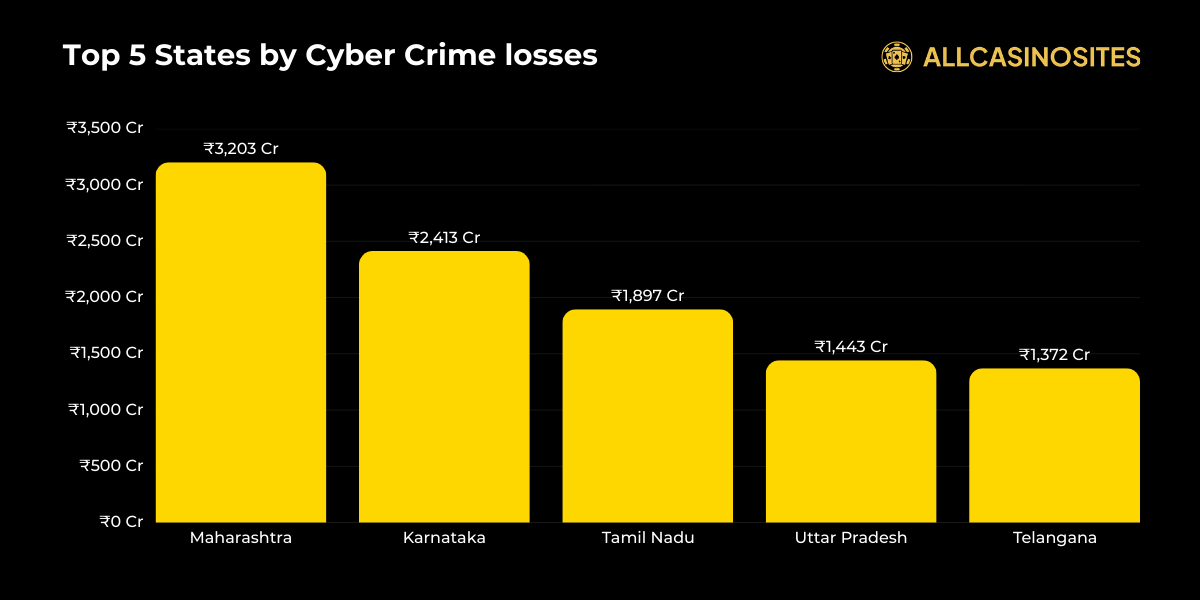
The table below shows the top 5 states that incurred the highest losses:
| State | Loss |
|---|---|
| Maharashtra | ₹3,203 crore |
| Karnataka | ₹2,413 crore |
| Tamil Nadu | ₹1,897 crore |
| Uttar Pradesh | ₹1,443 crore |
| Telangana | ₹1,372 crore |
All told, these five states are responsible for over half of India’s total fraud-related losses, highlighting the links between digital and gambling activity and financial exposure.
Source: YouTube 2
These are some of the major drivers for the Indian Gaming Bill, passed in August 2025, which imposed a strict ban on real-money gaming (RMG), its advertising, and financial transactions, imposing penalties like fines and imprisonment for violations, and establishing a new authority for sector oversight.
Source: PIB
Global Gambling Market Size
The global gambling market is estimated at $101.45 billion in 2026 and is projected to reach $168.84 billion by 2031, with a 10.72% CAGR.
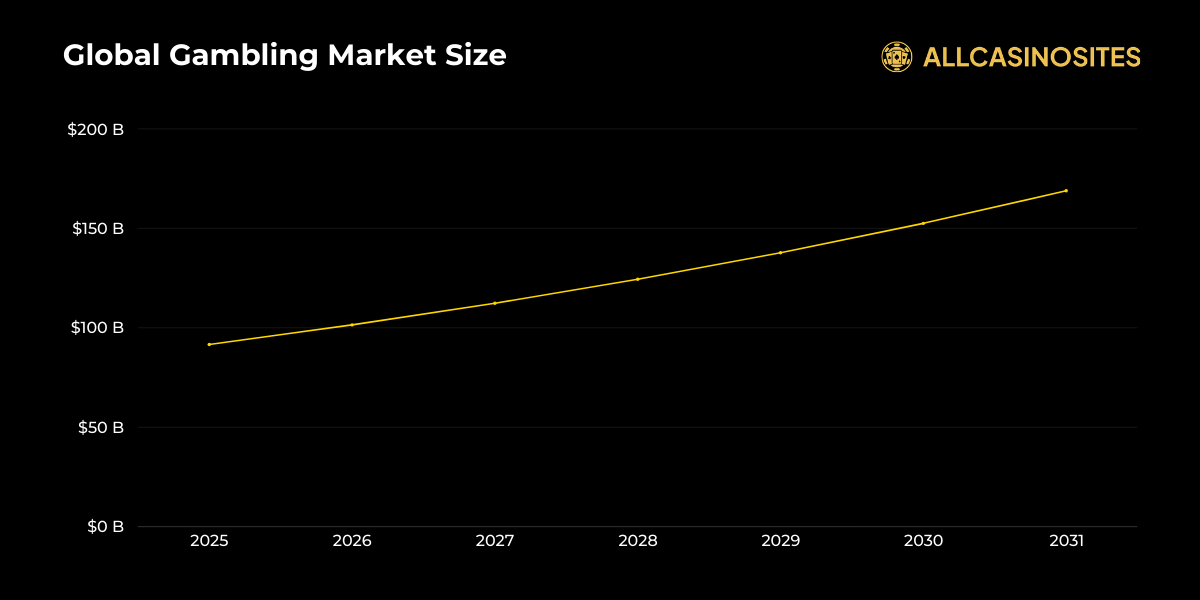
The table below shows the estimated growth of the Global Gambling Market:
| Year | Market Size |
|---|---|
| 2025 | $91.63 billion |
| 2026* | $101.45 billion |
| 2027* | $112.33 billion |
| 2028* | $124.38 billion |
| 2029* | $137.71 billion |
| 2030* | $152.48 billion |
| 2031* | $168.84 billion |
*Estimated Figures
The Worldwide online gambling market is still influenced by game types, technology adoption, and demographic characteristics of users.
In terms of game type, sports betting dominated the market in 2025, accounting for over 52% of total revenue and remaining the most profitable segment, registering a CAGR of 11.75% through 2031. That growth is very much driven by the rise of real-time betting and broadening sports coverage on digital platforms.
This momentum is supported by platform trends where mobile and tablet devices accounted for 53.65% of revenue in 2025. Because mobile betting is easy to use and widely available, it has become the fastest-growing segment, with a projected CAGR of 13.65%, during the forecast period (2026–2031).
Demographically, the market is dominated by 25-34-year-old users, who represented the largest share (24.30%) of the worldwide user base in 2022. In the meantime, younger users aged 18-24 years are becoming the fastest-growing segment and are anticipated to grow at a CAGR of 11.98% through 2031 due to growing participation of digital natives.
Live betting made up over 53% of betting activity in 2025, showing a strong preference for real-time wagers. This segment is also growing at a rapid pace and is poised to expand with a CAGR of 14.85% by 2031.
From a regional perspective, Europe continued to dominate the global landscape with 56.90% of the revenue share in 2025, owing to established regulations and high uptake levels.
But North America is expected to be the fastest-growing region with a CAGR of 15.40% throughout the forecast period due to increasing legalisation and expanding online betting infrastructure in the countries in this region.
Source: Mordor
Size Of The Online Gambling Industry
The global online gambling market was valued at $87.7 billion in 2025 and is expected to reach $153.57 billion in 2030, with an 11.9% CAGR.
In this, the European gambling market is the largest, accounting for over 41% of the global market share.
The table below shows the projected growth of the Online Gambling Industry:
| Year | Market Size |
|---|---|
| 2018 | $48,517.10 million |
| 2019 | $53,727.79 million |
| 2020 | $52,847.28 million |
| 2021 | $57,544.14 million |
| 2022 | $63,528.73 million |
| 2023 | $70,643.95 million |
| 2024 | $78,662.08 million |
| 2025 | $87,692.44 million |
| 2026* | $97,873.53 million |
| 2027* | $109,403.06 million |
| 2028* | $122,389.20 million |
| 2029* | $137,026.91 million |
| 2030* | $153,566.07 million |
*Estimated Figures
Source: Grand View Research
Online Gambling Demographics
Current estimates suggest that more than half of all American adults (57%) engaged in some form of gambling in 2025, highlighting the argument that gambling has become a widely accepted and normalized practice in the United States.
134 million adult Americans (53% of the population) visited a casino for gambling or non-gambling purposes in the last 12 months, an all-time high. This highlights that the physical casino industry remains an integral part of the broader gaming ecosystem and acts as a gateway to gaming for large segments of the country.
Source: AGA
As of September 2025, 87% of CYP in the UK have been exposed to content related to gambling through internet sources, which raises concern about public health implications for the normalisation of gambling among children and minors (largely influenced by online content and advertising).
Source: Gamble Aware
Online Gambling Statistics By Gender
Participation in online gambling is still very much dominated by males, particularly in established markets such as the US. The male proportion of the US online gambling market in 2025 was reported at 69.01%, and the predominance of male users on betting and wagering platforms remained uncontested.
This difference is on full display in sports betting, as nearly one in two American men between 18 and 49 has an active online sportsbook account, making them the bread-and-butter customer segment for operators who purport to cater to high-frequency bettors.
Source: Mordor, Siena
However, gender dynamics within online gambling are beginning to shift. While men still control the majority share, women represent the fastest-growing user segment in the US market, with female participation expanding at a compound annual growth rate of 10.12% through 2031.
Source: Mordor
This acceleration signals a gradual diversification of the user base and suggests that the gender gap, while still wide, is expected to narrow over the next decade.
A similar contrast between dominance and diversification appears internationally. In the United Kingdom, male users were significantly more active than females in emerging and higher-risk verticals in 2025.
Men were six times more likely to be in crypto trading, three times more likely to bet virtual money on esports, and eight times more likely to get involved in fantasy sports, so it would appear male gamblers are overrepresented among novel, less well-regulated types of gambling activity.
Source: Gambleaware
While casual play between women is definitely on the rise, so are more active female players. More than 10% of female sports fans in the United States had an online sportsbook account in 2025, showing a turning point for women and acceptance of sports betting and mirroring larger cultural changes in how people consume sports content and bet digitally.
Source: Statista
Together, these trends point to a market that remains male-led but is becoming increasingly gender inclusive over time.
Online Gambling Statistics By Age
Nationwide, active online sports betting account holders have firmly crossed into the mainstream in the United States, as 22% of all American adults are now active online sports betting account holders.
This penetration level means that betting online is no longer a niche or early adopter pursuit, but rather is now part of ‘mainstream’ digital entertainment for the vast majority of the adult population.
Source: Siena
Adoption is even more concentrated among younger demographics. As of September 2024, one quarter of American men under the age of 30 reported betting on sports online, confirming this group as the most active and engaged segment of the online sports betting market.
Yet, unfortunately, the young men most engaged are the most at risk. In 2024, a tenth of men under 30 in the US were considered problem gamblers due to online betting, more than the general population rate. This difference suggests that regular betting and continual access may contribute to an escalation of gambling harm within this age cohort.
This disparity highlights how frequent betting behavior and constant platform access can amplify gambling-related harm within this age group.
Source: FDU
Broader youth participation data reinforces this pattern. By October 2025, 17% of US adults under 30 had participated in online sports betting, a figure that exceeds overall adult participation rates and underscores the strong pull of sports wagering among the youngest legal betting demographic.
Together, these metrics point to youth-driven growth as a defining feature of the online betting market.
Source: Pew Research Centre
This transformation is also changing the broader gambling ecosystem. And as of 2025, the average age of US casino visitors is back down below pre-pandemic levels, proving that casinos are seeing a clear ROI when it comes to attracting the next generation through a hybridized approach spanning online betting, digital engagement, and in-person gaming.
Online Gambling Statistics By Country
By country, the highest revenue in online gambling is from the UK, at $7,371.5 million in 2024 and a projected $15,093.8 million by 2030. This means the UK will see its online gambling profits more than double in just six years.
This also places Europe as the most active region in terms of online gambling revenue, which stood at $32,379.1 million in 2024 and is set to reach $63,552.8 million by 2030.
Source: Grand View Research 2
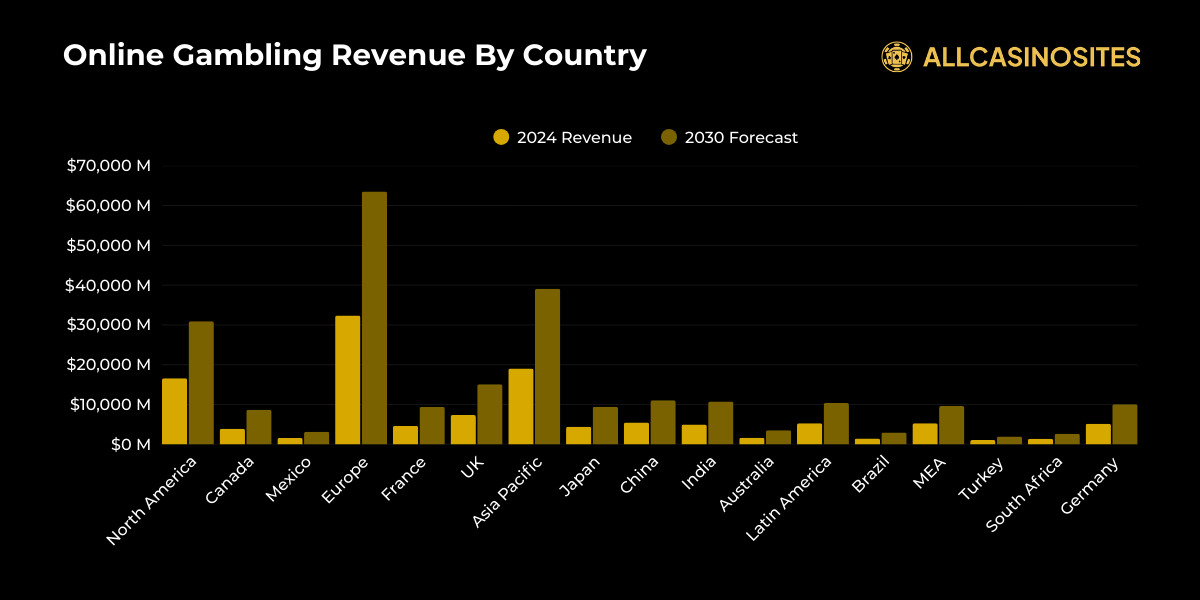
The table below shows the 2024 revenue and 2030 predictions of online gambling for various countries and geographical locations:
| Country and Geographical Region | 2024 Revenue | 2030 Forecast* |
|---|---|---|
| North America | $16,584.1 million | $30,915.7 million |
| Canada | $3,907.9 million | $8,722.5 million |
| Mexico | $1,616.9 million | $3,156.5 million |
| Europe | $32,379.1 million | $63,552.8 million |
| France | $4,642.4 million | $9,399.5 million |
| UK | $7,371.5 million | $15,093.8 million |
| Asia Pacific | $19,057.5 million | $39,079.8 million |
| Japan | $4,443.8 million | $9,447.6 million |
| China | $5,479.9 million | $11,057.4 million |
| India | $5,015.9 million | $10,776.7 million |
| Australia | $1,657.2 million | $3,556.3 million |
| Latin America | $5,330.9 million | $10,407.1 million |
| Brazil | $1,506.9 million | $3,011.7 million |
| MEA | $5,310.5 million | $9,610.7 million |
| Turkey | $1,092.0 million | $1,997.1 million |
| South Africa | $1,440.0 million | $2,663.1 million |
| Germany | $5,211.2 million | $10,085.8 million |
*Estimated Figures
Source: Grand View Research
Global online gambling participation information demonstrates that high-level involvement is ceasing to be confined to traditional gambling hotspots. Both Norway and South Africa were found to have participation in online gambling of 30% of internet users aged 16 plus as per the most recent information.
The parallel between an emerging African market and a Nordic country reflects that good digital infrastructure, providing access to mobile internet, facilitates similar gambling behaviours across vastly different economic regions.
Source: Intelpoint
Europe is showing how vast and sophisticated an online gambling market can be. The European online gaming and betting market contributed €47.9b to gross gambling revenue (GGR) as per the latest data, or 38.8% of GGR for the entire continent.
This figure underscores the extent to which online has developed as a core component of Europe’s gambling economy rather than an additional channel alongside land-based operations.
Source: Houlihan Lokey
Online gambling participation in the Australian Capital Territory rose to 26.9% of adults as per the last recorded data, reflecting accelerating adoption that mirrors national trends where online gambling continues to overtake venue-based participation.
Source: ACT
In the United States, the impact of legalization and regulatory expansion is especially pronounced. Online gambling revenues increased by 250% between 2015 and 2025, illustrating how policy shifts have rapidly reshaped the market.
Source: Altenar
Online Gambling Market Share By Sports Type
According to the latest data, basketball is the game that attracts the most gamblers, accounting for 26.5% of total gamblers.
Horse racing, a widely popular game for betting, draws 8.9% of the gamblers.
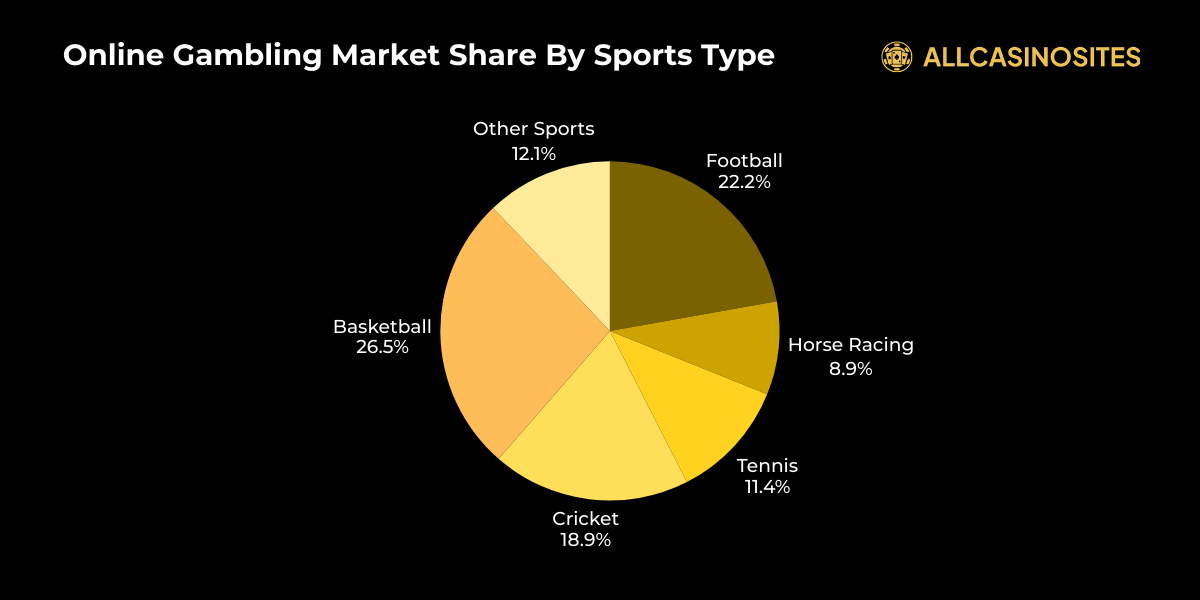
The table below shows online gambling market share by sports type:
| Game | Gambling Percentage |
|---|---|
| Football | 22.2% |
| Horse Racing | 8.9% |
| Tennis | 11.4% |
| Cricket | 18.9% |
| Basketball | 26.5% |
| Other Sports | 12.1% |
Source: GM Insights
Online Gambling Addiction Statistics
A survey conducted by NCPG revealed the following information on behaviour in problem gamblers:
Patterns of participation frequency, betting variety, and demographics reveal a clear link between online gambling engagement and the risk of problematic behavior. Individuals who participated across a wider range of gambling activities were significantly more vulnerable, with 28% of those engaging in 10 or more activities reporting problematic behavior.
Similarly, intensity of play emerged as a key risk factor, as 35% of individuals who gambled on three or more activities on a weekly or more frequent basis met the threshold for concern.
Risk levels also varied by gambling format. Fantasy sports bettors showed higher susceptibility, with 24% reporting problematic behaviors, compared to 17% among traditional sports bettors.
Age and gender differences further underscore uneven exposure to harm, as 15% of adults aged 18-34 reported concerning behavior, sharply higher than the 2% observed among individuals aged 55 and older.
Additionally, gambling-related problems were reported by 10% of men, nearly twice the rate observed among women, highlighting a pronounced gender gap in gambling-related risk.
Source: NCPG
Top Online Gambling Sites
Stake.com leads globally with over 109.7 million visits, indicating its dominance in the international online gambling ecosystem and its success in attracting repeat users at scale.
Platforms such as SportyBet show exceptionally high engagement, with more than 10 pages per visit and a low bounce rate, suggesting deeper user interaction and longer betting sessions.
In contrast, sites with high traffic but elevated bounce rates, such as Caliente.mx and Powerball.com, reflect more transactional or single-purpose user behavior rather than sustained gameplay.
Overall, the most successful gambling sites are those that combine massive reach with strong session depth, which has direct implications for customer lifetime value and platform revenue growth.
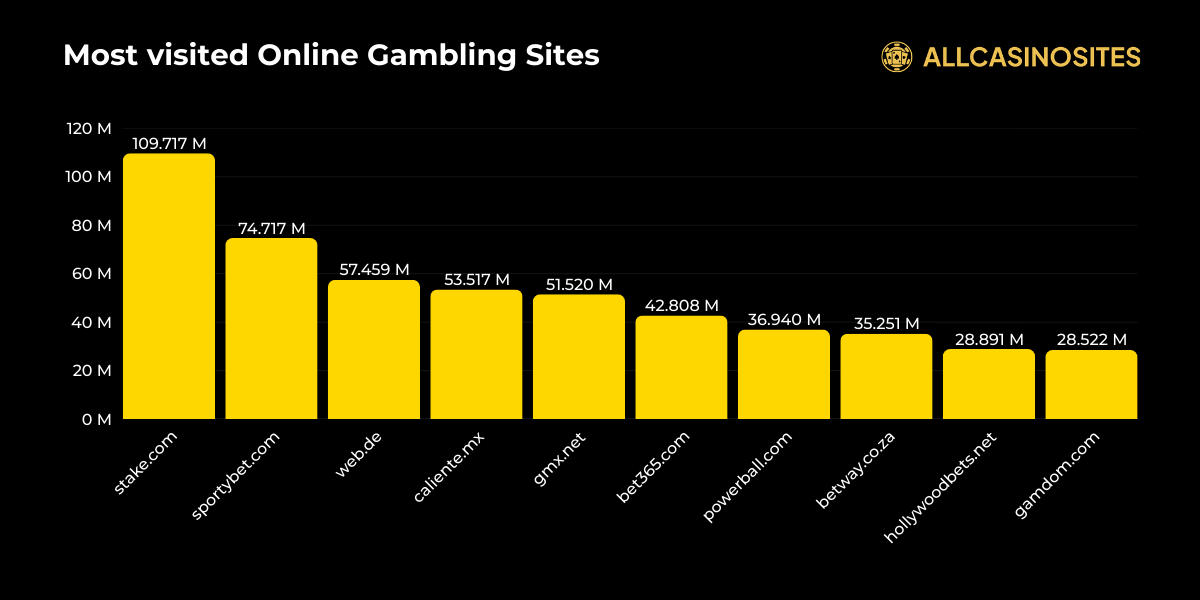
The table below shows the most visited gambling sites:
| Position | Website | Visits | Pages / Visit | Bounce rate |
|---|---|---|---|---|
| 1 | stake.com | 109,717,020 | 6.58 | 46.40% |
| 2 | sportybet.com | 74,716,958 | 10.45 | 18.55% |
| 3 | web.de | 57,459,191 | 7.88 | 25.46% |
| 4 | caliente.mx | 53,516,971 | 2.27 | 73.08% |
| 5 | gmx.net | 51,520,376 | 7.67 | 21.82% |
| 6 | bet365.com | 42,808,462 | 6.31 | 44.43% |
| 7 | powerball.com | 36,939,621 | 1.9 | 69.32% |
| 8 | betway.co.za | 35,251,218 | 4.06 | 56.13% |
| 9 | hollywoodbets.net | 28,891,364 | 4.4 | 30.33% |
| 10 | gamdom.com | 28,521,829 | 6.2 | 35.79% |
Source: Semrush
Online Gambling Legality Status Across the World
Note: The legality of online gambling varies by country, influenced by cultural/religious beliefs and updated laws.
The legality of gambling varies widely across nations due to legal, cultural, and regulatory factors. Some countries fully license and regulate online and offline gambling to protect players and ensure fair operations, while others operate under general laws that create gray markets with limited oversight.
In certain jurisdictions, gambling is strictly prohibited, with enforcement measures such as website blocking, payment restrictions, and legal penalties.
The table below highlights the top 20 countries, outlining their online and offline gambling legality and the regulatory bodies responsible:
| Country | Online Gambling | Offline Gambling | Regulatory Body / Primary Law |
|---|---|---|---|
| United Kingdom | Legal & regulated | Legal & regulated | UK Gambling Commission |
| United States | Mixed (state-by-state) | Legal (varies by state) | National Indian Gaming Commission+state regulators. |
| Malta | Legal & regulated | Legal & regulated | Malta Gaming Authority (MGA) |
| Germany | Legal & regulated | Legal & regulated | Glücksspielbehörde der Länder (GGL) |
| Spain | Legal & regulated | Legal & regulated | Dirección General de Ordenación del Juego (DGOJ) |
| Italy | Legal & regulated | Legal & regulated | Agenzia delle Dogane e dei Monopoli (ADM) |
| France | Legal & regulated (exceptions) | Legal & regulated | Regulated licensed market for certain gambling |
| Netherlands | Legal & regulated | Legal & regulated | Kansspelautoriteit (KSA) |
| Sweden | Legal & regulated | Legal & regulated | Swedish Gambling Authority (Spelinspektionen) |
| Australia | Illegal (most online) | Legal (land-based) | Complex federal/state laws |
| Canada | Legal/regional | Legal/regional | Provinces regulate gambling |
| China | Illegal | Legal (state lotteries) | Gambling is prohibited under national law |
| Japan | Mostly illegal | Legal (pachinko & regulated casinos) | Casinos are legal under strict laws |
| Brazil | Online legal (regulating) | Land-based limited/regulated | Brazil legalized online betting |
| Colombia | Legal & regulated | Legal & regulated | Colombian Gaming Regulator (Coljuegos) |
| Philippines | Regulated (land-based & offshore zones) | Legal (special zones) | Philippine Amusement and Gaming Corporation |
| Ukraine | Legal & regulated | Legal & regulated | Ukrainian Commission for Regulation of Gambling and Lotteries |
| Finland | Government monopoly | Government monopoly | Land-based and online only through a state monopoly. |
| New Zealand | Online limited/legal | Legal | Gambling is permitted with licensing; it restricts certain online activities. |
| India | Illegal | Legal with geographical limitations | New Promotion and Regulation of Online Gaming Act |
Economic & Social Impact of Online Gambling
The world of online gambling has become a big part of the digital economy, and it’s expected to reach $153.57 billion by 2030 (as seen in the above section), nearly double what it was in 2024, with $78.66 billion at a CAGR rate of 11.9%.
This expansion is primarily due to smartphone penetration, high-speed internet, and mobile-first betting platforms that have increased participation across geographies.
In regulated markets, this growth yields tangible macro-economic value. In the US, the gaming industry contributed 1.8 million jobs and $329 billion in economic output as per the latest data, including $104 billion in wages and significant spillover effects throughout technology, hospitality, and media.
Source: AGA
This effect is rounded off by tax revenues, with U.S. commercial casinos and online gaming paying $53 billion in taxes in 2022 to help fund public works without the need for raising general taxation levels. Job growth also captures the impacts of legalization, as 36,264 individuals worked in online gambling services in 2025 (an increase of 37.1% since the repeal of PASPA).
Similar fiscal efficiency is visible in Europe, where Portugal’s regulated online market generated €284.7 million in Q1 2025 alone, yielding €95.5 million in tax revenue for the state.
Source: IGT
Markets like India had similar economic value in parallel markets. Contribution to GDP and growth rate: As per our estimates, online gaming contributed ₹22,000 crore to GDP in FY23, growing at 22% annually. The contribution and the growth underscore its role in the base of digital exports (like any software industry), with almost entirely skill-based employment, and as platform driven economy expansion.
Source: NiftyTrader
Europe remains the largest global revenue contributor due to mature regulation and high user penetration, while North America captured 21.1% of global market revenue in 2024 as legalization accelerated across U.S. states and Canada.
Source: Grand View Research 2
However, these economic gains are increasingly offset by measurable social and financial costs. Evidence from U.S. states that legalized online sports betting shows a 1% decline in average credit scores after four years, alongside a 28% rise in bankruptcies and an 8% increase in debt collections.
Source: Business Insider
These findings indicate that low access and seed availability are potential drivers of financial stress, especially among younger men. At the population level, gambling harm impacts 11.9% of men and 5.5% of women worldwide and results in chronic strain on healthcare services, family finances, and social welfare systems.
Source: WHO
Country-specific data reinforces these concerns. Finland reports a past year problem gambling prevalence of around 3%, yet problem gamblers account for roughly 35% of industry profits, highlighting how revenue concentration deepens inequality.
Source: Academic
In the UK, problem gambling among ages 11 to 17 more than doubled from 0.7% in 2023 to 1.5% in 2024, while 27% of UK youth reported spending their own money on gambling in the past year. This early exposure raises long term risks of addiction and future economic dependency.
Source: Gambling Commission
Severe individual outcomes are also well documented. Nearly 19.2% of pathological gamblers have filed for bankruptcy compared to 5% of low-risk gamblers, while members of Gamblers Anonymous report bankruptcy rates between 18 and 28% with average debts ranging from $42,000 to $53,000.
Source: NIH
In the United States alone, problem gambling imposes an estimated $7 billion in annual social costs through healthcare expenses, crime, job loss, and insolvencies, partially offsetting the industry’s GDP and tax contributions.
Source: Birches Health
Online formats consistently show higher rates of problematic gambling than land-based alternatives, due to constant access, immersive design, and frictionless payments. This risk is magnified in lightly regulated markets such as India, where an estimated 45 crore people lose approximately ₹20,000 crore annually to real-money gaming, as seen before.
Source: ET
Regions with high cultural acceptance also reflect elevated exposure. Australasia records the world’s highest adult gambling participation rate at 70%, correlating with increased demand for social and mental health services.
Source: GREO
This way, online gambling creates a double economic reality. And while this delivers significant tax, employment, and revenue upside in regulated markets, the social costs only increase exponentially with accessibility, especially in a digital-first world.
The long-term impact depends on how market growth is balanced with regulation, consumer protection, and harm prevention.
